Ultimate Lofoten Islands Travel Guide From A Local (2025)
So you are finally coming to Lofoten? Yey! Then you are in need of this extensive Lofoten Islands Travel Guide I have created, with my best tips from a local (you welcome).
I am so happy for you, and you have arrived in just the right place to do your research before your epic trip to Lofoten.
I am a Norwegian native, living in my own quirky old white wooden traditional Fisherman’s house in Reine, all the way west in Lofoten, so I genuinely have the first-hand know-how.
Starting with how to get here, all the destinations, the plethora of amazing things to do, where to hike, when to travel, where you can stay to get the perfect journey, and everything else you did not know you needed to know.
Let’s get into your Ultimate Lofoten Islands Travel Guide!
The Ultimate Lofoten Islands Travel Guide
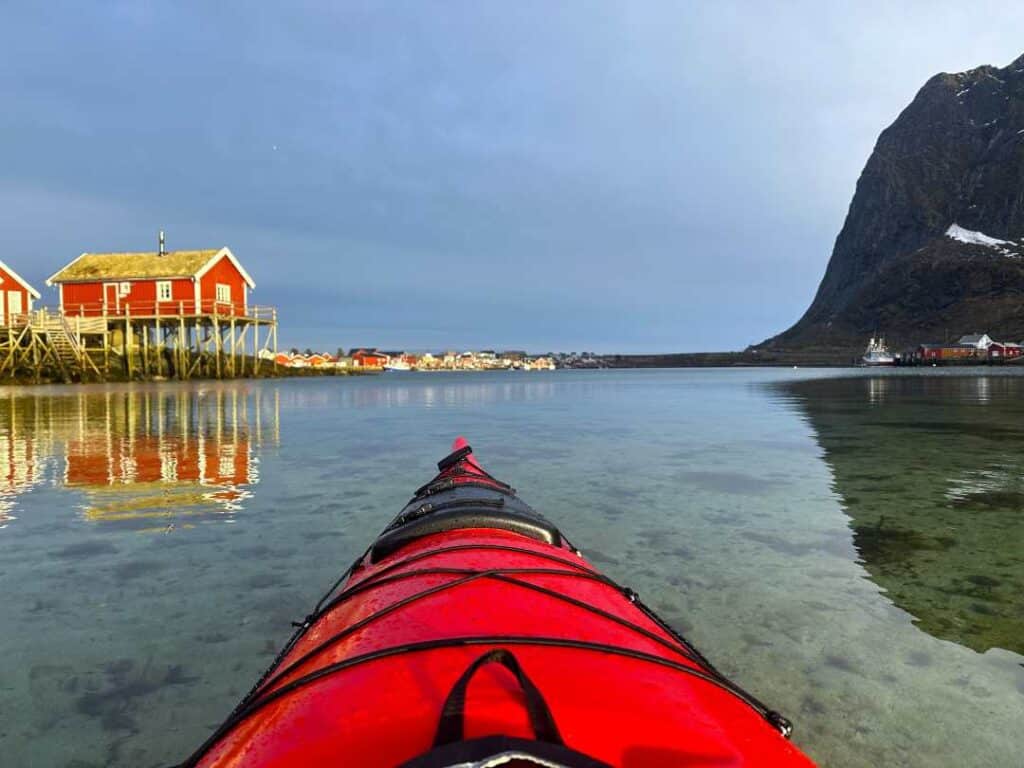
This guide is structured with destinations from the NORTH to the SOUTH in Lofoten, or east to west, as the locals say.
If you want to go in-depth on any destination or topic, I will link to detailed articles that might be relevant for you.
And if you know exactly what you are looking for or what destinations you want to study, just use the table of contents above and go straight to where you need to be.
First: How To Get To Lofoten
There are three main ways to get to the Lofoten Islands, and one slow, scenic one:
- Fly Wideroe Airline to one of the three nearest airports
- Take the ferry from Bodø Town on the mainland to Moskenes Ferry Port
- Drive from the north – either by car or take the bus
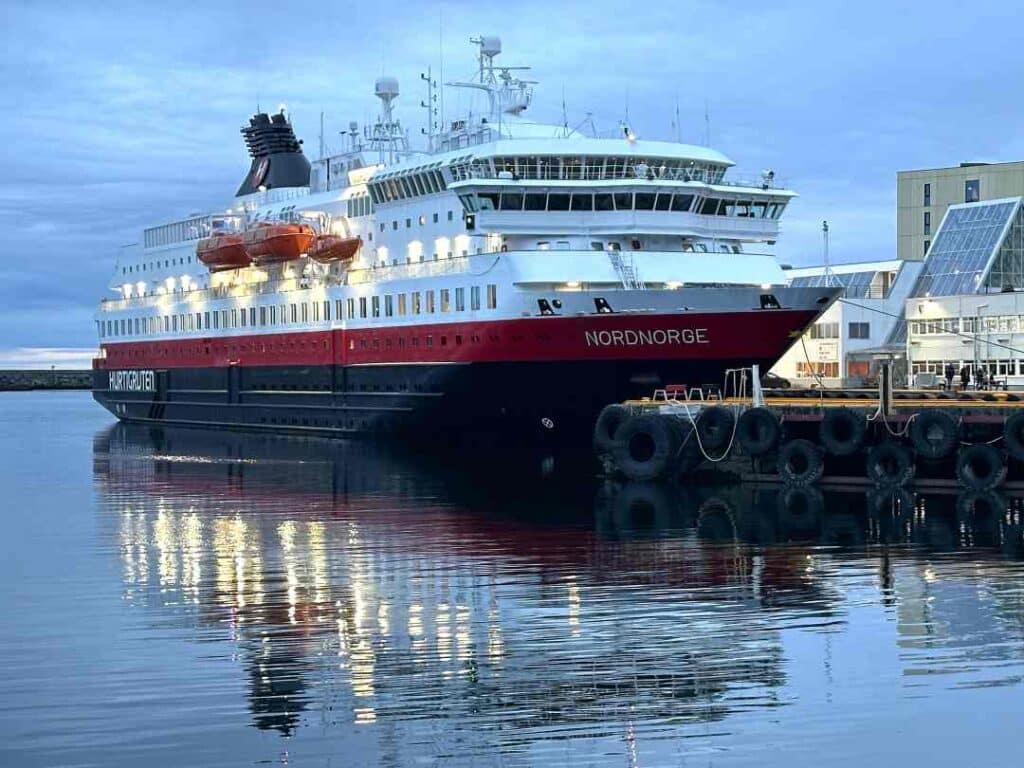
- Slow: the Hurtigruten Coastal Ferry (From Bergen to Kirkenes) docks daily in Svolvær
Fly to Lofoten – Three Lofoten Airports
There are three airports in northern Norway from where you can reach the Lofoten Islands, two of them are on the archipelago, and one is slightly to the north.
- Harstad/Narvik Evenes Airport
As the name implies, this airport is located between the two small towns of Harstad and Narvik in Northern Norway. The drive from Evenes Airport to Å, the end of Lofoten, is a little more than five hours.
A lot longer, though, if you stop a lot for photos, coffee, and meals.
This is where you fly to if you want a longer road trip through all of the Lofoten Islands, and also if you want some flexibility and maybe want to visit other destinations like Senja and Andøya islands north of the Lofoten Islands.
2. Svolvær Airport
Svolvær Town is the “capital” of Lofoten, the northernmost town. From Svolvær to Å, it is a journey of around 2,5 hours and up (depending on traffic, weather, and how often you stop for a mini photo shoot).
3. Leknes Airport
Leknes Airport is located in the “middle” of the Lofoten Islands; from here, it is about a one-hour drive northeast to Svolvær, and a little over one hour southwest to Å in Lofoten.
As Leknes is the last town on your way west, this is your last chance to visit a bigger supermarket, do your shopping, or stock up on wine for your Lofoten trip. After this point, you will only find small supermarkets and a few gas stations.
(NOTE that in Norway, wine and liquor are only sold in designated shops called Vinmonopolet).
Take The Bodø – Moskenes Ferry
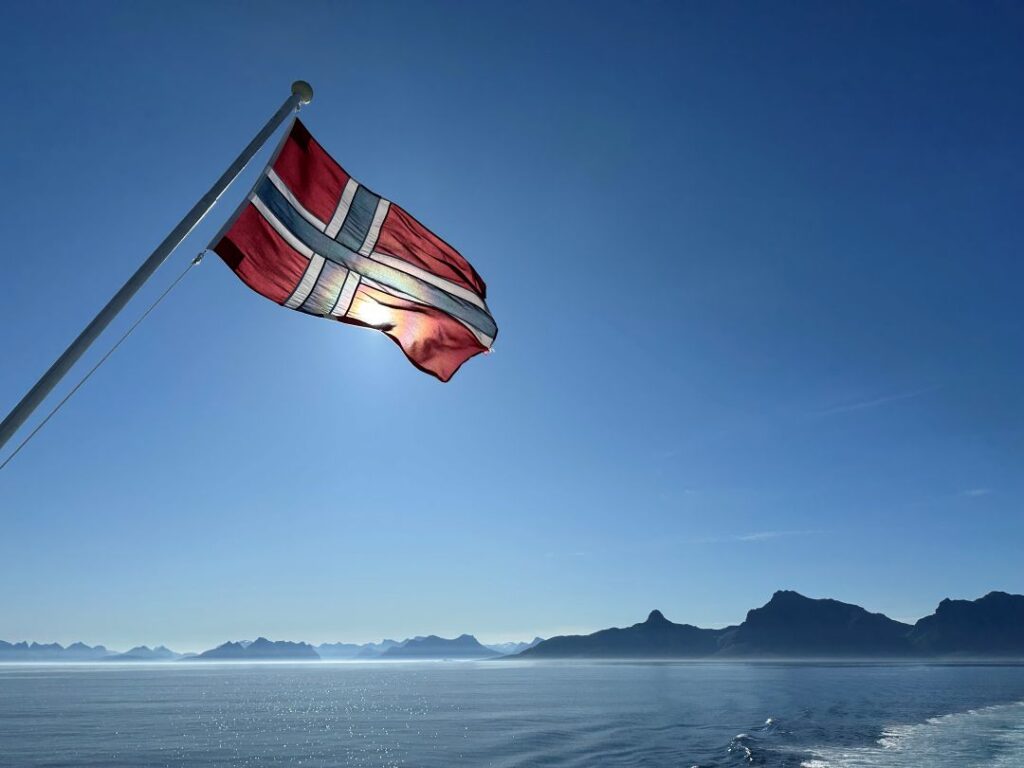
From Bodø Town on the mainland, you can take the car ferry across the West Fjord to arrive in Moskenes, western Lofoten. This is a journey of around three and a half hours, and is really popular in the summer for people on road trips.
Departures are numerous in June, July, and August, but I still strongly advise booking a ticket beforehand if you travel with a car. This ferry is super popular, and without a pre-booked ticket in the summer, you and your car can easily get left behind a fully booked ferry.
If you are backpacking and/or traveling by public transport, without a car, there is no need to pre-book a ticket. Also, as a pedestrian, the ferry trip is free (amazing, right? Some things are still free in Norway).
In the winter, departures are fewer, and as there are also fewer tourists, it might not be necessary to pre-book even with a car.
I still recommend you check the website Torghatten for departure times, and you can also book your tickets here if you choose to.
NOTE: During shoulder season and the winter (and occasionally also in the summer), you should pay close attention to the weather forecast and the Torghatten web page!
The ferry is the first thing to be cancelled during stormy weather in Lofoten. So if you are traveling during periods with a lot of weather, make sure you have a time buffer and stay tuned to the weather reports.
📍Travel To Norway Tip: The Torghatten Ferry connection also has departures to the two small islands south of Lofoten, Værøy and Røst. These are really off the beaten path, and amazing summer destinations if you are into hiking, biking, or bird watching (especially puffins).
Lofoten Road Trip Or Public Bus Travel
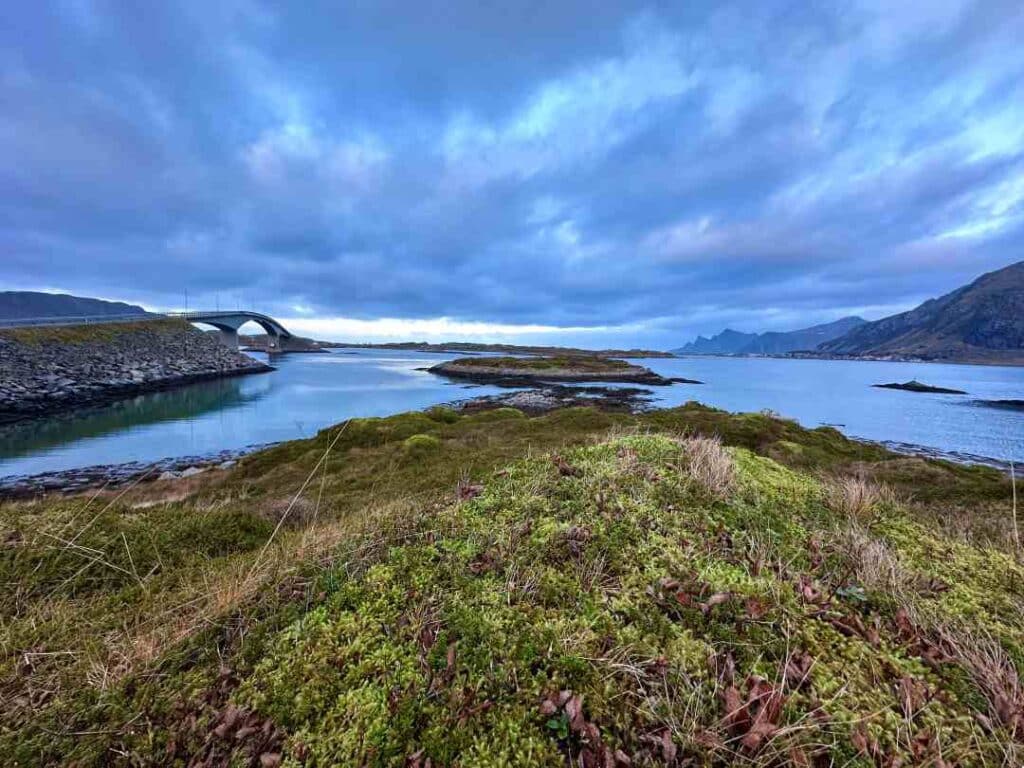
Road Trip
Lofoten is a good destination for a road trip; however, I do want to put some caveats on that statement.
There is only one road winding its way along the Lofoten Islands, the E10, and many of the destinations you want to visit are not within walking distance of one of the bus stops. Therefore, having your own car definitely gives you the most freedom and flexibility to explore.
That said, you are not the only one exploring Lofoten by car, especially in the summer, so during June through to August and September, there is going to be traffic.
If you stay in vacation mode, don’t stress, and are prepared for this traffic, you will be fine.
Also, if you choose to do a road trip in winter, please consider your winter driving skills. In Lofoten, you have to deal with both the narrow roads and winter driving conditions, which can be challenging.
📍 Travel To Norway Tip: If you decide to do a road trip in the winter and you are not used to driving in winter conditions, please read this article about how to drive safely in winter road conditions – it will help you feel more confident and also be a better driver.
Public Transport
Bus departures are not abundant, but traveling by bus is absolutely a possible way to go if you do your research. There are more buses departing during the summer than in winter.
As long as you plan well, visiting Lofoten by bus is absolutely possible, but more challenging than with a car. So please do your research.
Check bus departures on the website Reis Nordland, and you can also download their app and buy tickets online.
NOTE: When you pass Leknes and head further west in Lofoten to Ramberg, Reine, and Å, there will be NO taxi service available. None. So if you think you will be able to just call a taxi or an Uber, let me inform you right now that you will not.
Must-See Lofoten Destinations

Some people travel to Lofoten again and again, but most don’t.
So if you are doing “THE Lofoten trip of a lifetime”, this is where I will help you decide what destinations you don’t want to miss while you are here.
Let us start with the “capital” of Lofoten, Svolvær Town.
1. Svolvær Town – Capital Of Lofoten
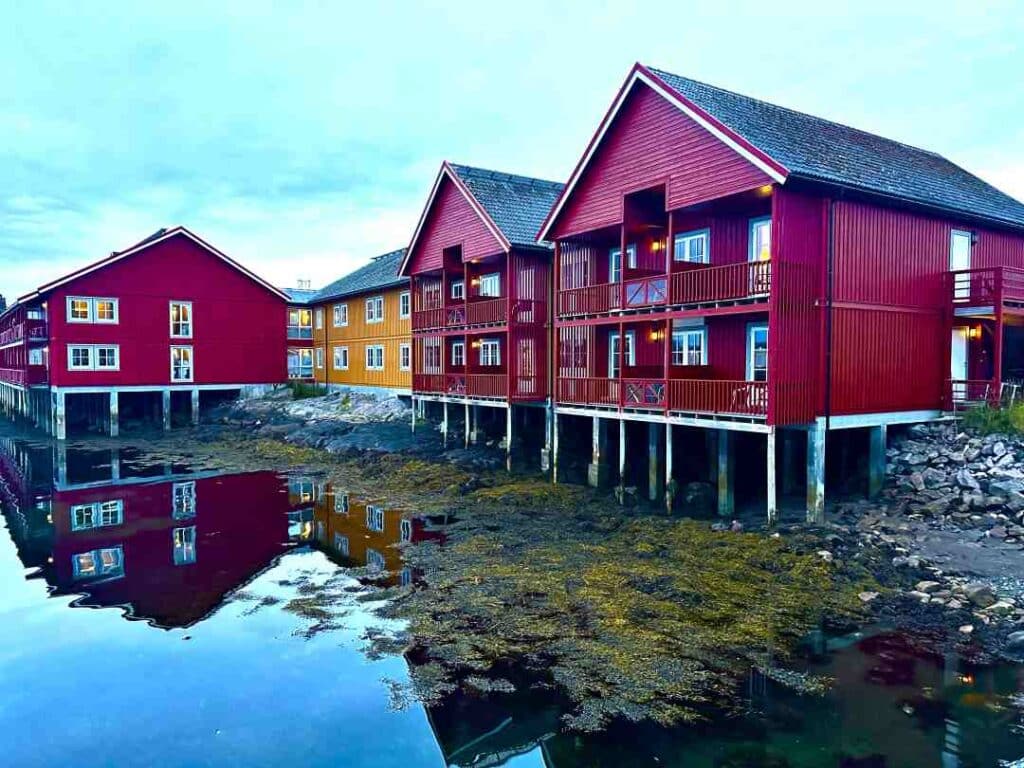
Svolvær is an actual small town, with a town square, lots of shops, some supermarkets, great restaurants, hotels, rorbuer (fishermen ‘s cabins), and of course lots and lots of amazing adventures at sea or in the mountains to explore.
The local population is around 4700, and the town still has an active fishing industry. You may have heard about the skrei, the seasonal cod that is a lot bigger than normal cod?
Well, there is an annual world championship of skrei fishing here in Svolvær.
The most famous landmark in Svolvær is Svolværgeita (the Svolvær goat), the characteristic mountain just outside the town center. You can hike almost to the top of “geita”, but the last bit you have to rock climb.
This climb is super popular among rock climbers, not least because of the challenge on the summit, where there are two rock columns stretching towards the sky, and the challenge is to jump between them.
That is an airy experience and not for the faint of heart!
Svolvær also has its own airport, Svolvær Airport Helle, and the Hurtigruten Coastal Ferry also docks here once a day.
The distance from Evenes Airport to Svolvær is 164 kilometers, and it takes about two and a half hours by car (depending on traffic, weather, and road conditions).
Things To Do

Like all destinations in Lofoten, the most popular and most spectacular things to do in Svolvær have to do with nature, whether mountains or ocean.
- Hike (and maybe climb) Svolværgeita
- Other popular hikes from Svolvær:
- Fløya & Djevelporten (The Devil’s Gate)
- Blåtinden
- Tuva
- Sea kayaking
- Small group cruise to Trollfjord
- Trollfjorden Fjord & Sea Eagle RIB Safari
- Deep-sea fishing
- Stroll over to the tiny Svinøya Island
- Visit the Lofoten War Memorial Museum
- Take a session on a floating fjord sauna
- Visit Sildpollnes Church
- Sample beer at Lofotpils Brewery
Where To Eat
There are a variety of good options in Svolvær, including hotels. Here are three of my favorites:
- Bacalao on the harbor
- Børsen Spiseri Svinøya Island (walking distance)
- Paleo Arctic inside the Thon Hotel
Where To Stay
As Svolvær is an actual town, you find hotels here, not just rorbuer (Fisherman’s cabins) (although that, too), and Airbnb.
Here are three top-rated suggestions for places to stay suitable for different budgets, and one camping site.
Svinøya Rorbuer
Step into the heart of Lofoten’s coastal heritage with a stay at Svinøya Rorbuer, located on the small island Svinøya (walking distance from town center) where traditional red fishermen’s cabins meet a touch of cozy luxury by the sea.
Connected to Svolvær by a bridge, this iconic retreat offers an amazing traditional ambiance. You will love the atmosphere both in the cabins, in the charming restaurant (incredible food!) and bar, and the quirky old-fashioned reception area.
Thon Hotel Svolvær
Thon Hotel Svolvær is a modern architectural building sitting right by the town center and harbor, super close to where the Hurtigruten Coastal Ferry arrives once a day.
This is a modern and top-rated hotel, where you have stylish rooms, stunning views, an amazing on site restaurant and bar, fitness center, highly rated breakfast in stunning surroundings, free WiFi, EV charger, and more.
Budget: Lofoten Rorbuer
Located slightly outside the town center, Lofoten Rorbuer is a top-rated, super charming and quite budget friendly stay for Lofoten standards. Here you will find a shared kitchen, bike hire, outdoor fireplace, and free private parking.
In your rorbu, you find a kettle, TV, free WiFi, and some of the rooms have a terrace and sea view (request this in your booking if it is important for you.
Hammerstad Camping
Hammerstad Camping Site located about 9 kilometers north of Svolvær Town has both cabins for rent, as well as space for mobile homes, and tent sites.
2. Skrova Island

Nestled in the shimmering waters of Vestfjorden, about 30 30-minute ferry ride from Svolvær, lies Skrova Island, with the nickname Lofoten’s “Hawaii” or Photo Island due to its stunning white sand beaches.
With fewer than 200 residents, it thrives as a close‑knit, vibrant fishing community enriched by art galleries, outdoor photo exhibitions, and a distinctly authentic local culture.
Visiting Skrova Island is really easy (as long as the weather is kind): board the free car or foot passenger ferry operated by Torghatten from Svolvær (Osan terminal) to Skrova village; the journey takes around 30 minutes and runs several times daily in summer, often via Skutvik Bay.
Alternatively, the express boat service (hurtigbåt) from Bodø stops at Skrova en route to Svolvær.
Once there, explore graceful hiking trails up Skrovafjellet, enjoy kayak adventures amid pristine beaches and wildlife, wander art walks, or soak in the tranquility of island life — all in a compact, picturesque setting that feels miles beyond the ordinary
Things To Do
Skrova is a small island; hence, the list of things to do is not the longest, and the island is home to fewer than 200 permanent residents. But there are a few things you should do when you have found your way over.
- Visit one of the photo galleries
- Hike up the Skrova Mountain (easy hike)
- Hike to Hattvika Beach
- Visit the old coastal fortress built by the Germans in the 40ies
- Amazing photo
Where To Eat
For such a small place as Skrova, you still have a few dining options to choose from.
- Heimbrygga (also called Fotobrygga)
- Skrovabrygga
- PopUp (summer)
Where To Stay
Accommodation in Skrova is not abundant, so if you want to stay here for a night or two, it can be smart to plan ahead.
The accommodations that are there, though, generally get really good reviews.
3. Kabelvåg
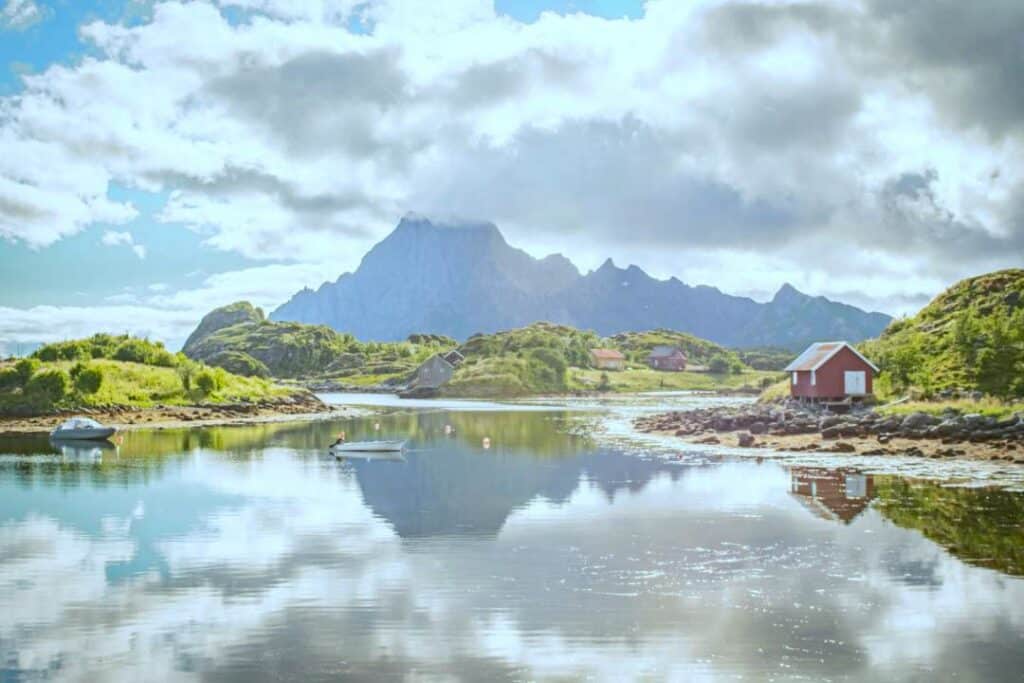
Just a short drive outside Svolvær to the west, you find a tiny village called Kabelvåg.
This small community was once the most important fishing village in the region; it’s now a cozy blend of history and charm, with colorful houses, an impressively big church for such a small place, and a harbor that looks like it was designed for daydreaming.
You can wander its quiet streets, pop into an art gallery or two, and imagine the days when hundreds of fishing boats filled the bay.
And when the golden evening light hits the mountains behind the village? Pure magic.
Things To Do
Kabelvåg is a small village, so there is not a lot to do in Kabelvåg itself.
But, like many destinations in Lofoten, it is a great starting point for hikes and exploring, and some adventures start right there in the little village.
- Visit the Lofoten Aquarium and Lofoten Museum
- Admire art in Espolin Gallery
- Do a guided kayak tour
- Visit Vågan Church (also called the Lofoten Cathedral)
- Stroll the harbor
- Walk over to Nyvågar
- Hike trails like Tjeldbergtind or Storvågan
Where To Eat
Where To Stay
There are a few options across the budget board for you if you choose to stay in Kabelvåg.
- Nyvågar Rorbuhotel (Fishermans Cabin hotel)
- Lofoten Apartments
- Skårungen Hotel, Cabins and Camping
4. Henningsvær

Aaaawww, Henningsvær.
A few kilometers outside Svolvær heading west, this iconic small village or settlement is located a couple of kilometers off the E10 down a winding, narrow road, and is sitting on a tiny island on the shore.
Henningsvær is famous for its football field covering almost an entire island, as well as the unique vibe in this community, with lots of cultural sights (for such a small place), incredible charm, great dining, and especially the chill vibe in the summer.
Make sure you stop at Klatrecafeen (climbers cafe) for lunch, have a cold drink in the sun outside Trevarefabrikken (the old refurbished woodwork factory, also a B&B), or browse local art.
From Henningsvær, you can also head out on great adventures hiking, biking, or out to sea.
What To Do
- Visit Galleri Lofoten
- Join a Sea Eagle & Seal Safari
- Explore Kaviar Factory Art Gallery (that used to be a caviar factory)
- Go Deep Sea Fishing
- Visit Engelskmannsbrygga artisan market, ceramic and glass blowing studio
- See the scenic Henningsvær Football Field
- Go kayaking or SUP
Where To Eat
Henningsvær has become a really vibrant, international community, with people moving here from other places in Norway, as well as from abroad, in addition to the many seasonal workers – and of course, travelers.
Like many places in Lofoten, this means that there is also a growing food scene, and you can have amazing, fresh seafood in Henningsvær.
- Must visit: The cool Trevarefabrikken (the old woodwork factory)
- Vind Brasserie
- Cafe Knusarn in Henningsvær Guesthouse
- Charming Klatrekafeen (Climber’s cafe, try the fish soup)
Where To Stay
- The trendy, vibrant Trevarefabrikken
- Tobiasbrygga Docks
- Villa Bryggekanten, elegant and cozy
- Best budget: Finnholmen Brygge
5. Leknes Town
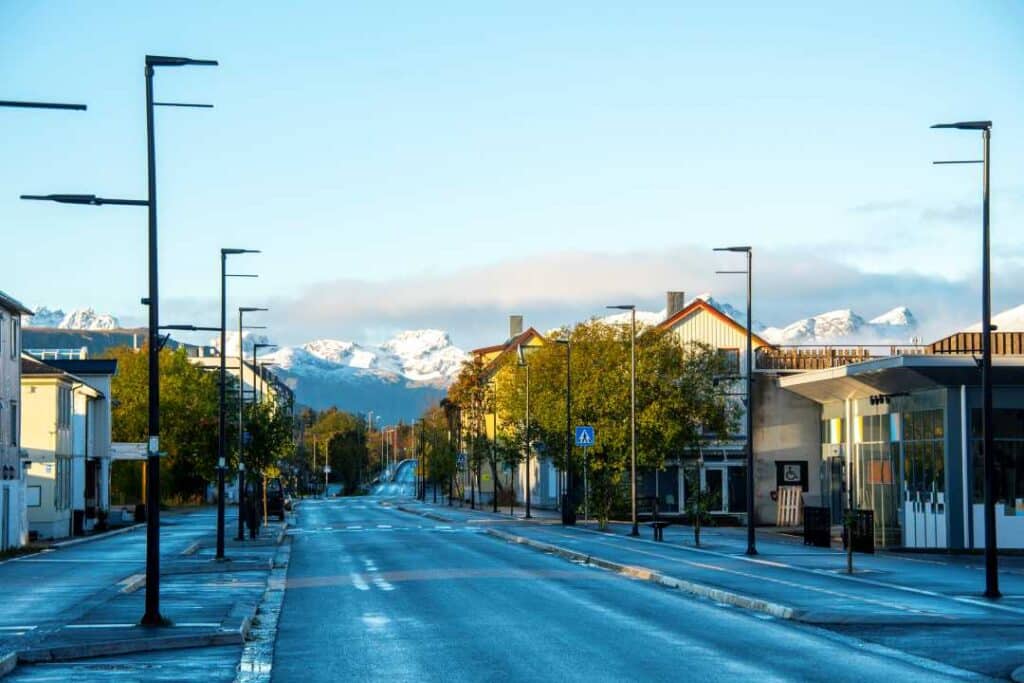
Leknes is a small town halfway down the Lofoten islands, and this is the last places to find larger supermarkets, shops, and the Vinmonopolet wine shop if you are heading from Svolvær towards the west.
Also, Leknes is probably the least spectacular destination in Lofoten, surrounded by mellow round hills and farming fields, and the more majestic mountains Lofoten is know for in the distance.
It is still a great starting point for adventures in Lofoten, and Leknes is also located close to a couple of the most famous beaches in Lofoten; Uttakleiv, Haukland, and Unstad beaches.
📍 Travel To Norway Tip: For backpackers and public transport travelers, the local (regional) bus stops and departs on the main bus stop next to the Circle K gas station in Leknes, see departures at Reis Nordland.
Things To Do
- Visit Unstad, Haukland, or Uttakleiv beaches
- Experience Lofoten Wool
- Visit the Viking Museum at Borg, right outside town
- Do the Offersøykammen hike (short, but a bit steep)
- Stop by Buksnes Church in Gravdal
- Get wine at the Wine Monopoly store chain
Where To Eat
Being a small town, there are a few places to eat in Leknes that generally receives good reviews.
- Makalaus on the main street (I like the ambiance and food here)
- Restaurant Bevares
- Sakura Lofoten sushi
Where To Stay
As Leknes is almost inlands, despite being in the Lofoten Islands, you will not find any waterfront accommodation here.
But if you prefer to have this small town as your Lofoten base, there are good options for accommodation in or just outside of Leknes.
- Scandic Hotel Leknes
- Lofoten Overnatting budget choice
- Lofoten Base Camp 4K outside town
- Statles Rorbu & Conference Center 7K outside town
5, Vikten & The Glass Factory

About 15 minutes west of Leknes you pass by a place called Vareid, and if you keep to the right in the 90* left turn at Vareid, you will shortly arrive in Vikten (there is a sign).
This is a bit off the E10, and the reasons for the fame of this places is the glass blowing center called Glasshytta.
The facility consists of a glassblowing workshop, a ceramics workshop, an exhibition and sales area, and a café.
During the summer season you get to see glass blowers at work in the workshop every day, and there is also a small cafe, with super tasty home made cakes or just a refreshment.
6. Nusfjord
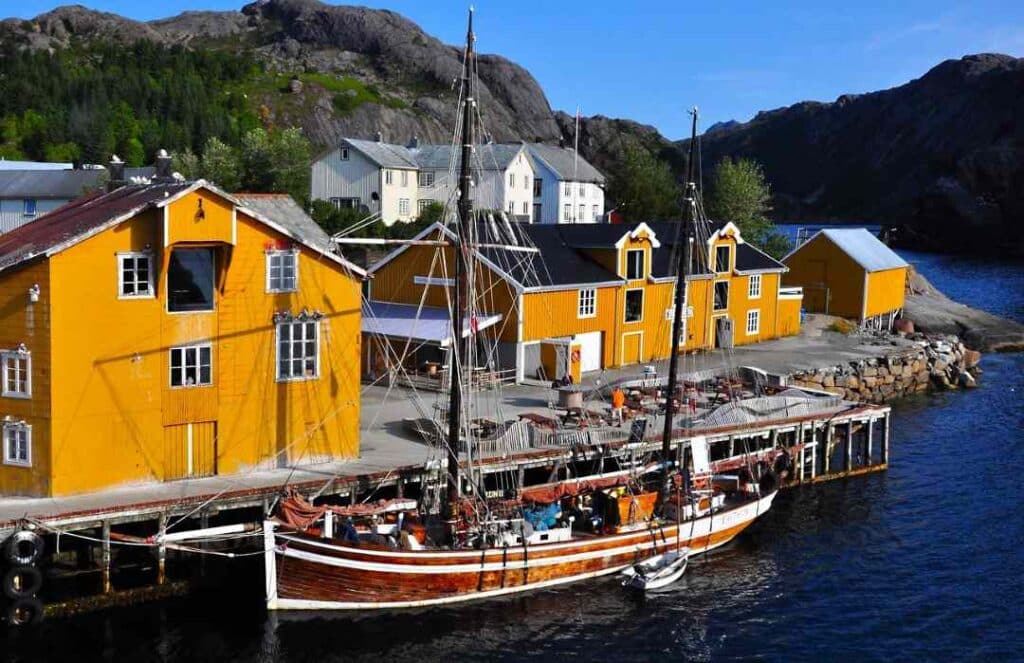
Nestled around ten kilometers off the E10, you find Nusfjord, a word that actually means kiss-fjord in Norwegian (how cute is that?).
Nusfjord has become an attraction just by being a picturesque, charming fishing village, with the old yellow houses, the little harbor, and the incredible surroundings.
Due to its popularity, Nusfjord is no longer a normal, open village to visit. You have to pay to enter Nusfjord now, and you park just on the outskirts of the small village. This place is so small it is almost not a village at all, but more like an old fisherman’s homestead.
Yet, it is super charming, and you find several places to eat and a few things to do both in and from the village.
Things To Do
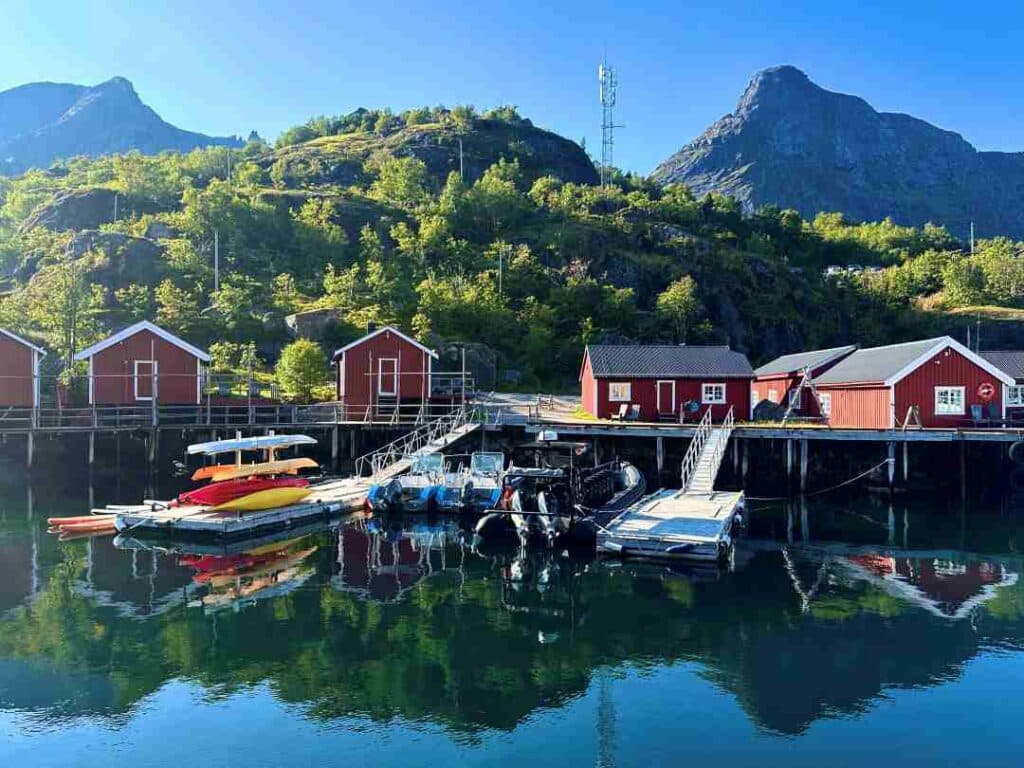
There are a few nice things to explore in Nusfjord, apart from taking in the ambiance, and there are also a couple of nice short hikes you can do from here.
- Visit Salteriet Gallery
- Join a guided kayak tour
- Visit the old store Landhandleriet (also the cafe)
- Hike to the lighthouse (easy)
- See the old boat houses along the harbor pier
- Hike to Nesland (easy/medium)
Where To Eat
There are several dining options in Nusfjord, from an authentic but high-end dining experience, to pizza, and a traditional cafe with simple but tasty dishes.
Places To Stay
In Nusfjord, there is only this one small cluster of wooden buildings composing Nusfjord village, so in the middle of this is where you are going to have to stay if you stay here.
📍 Check out this top-rated day trip to Nusfjord and Henningsvær from Svolvær.
7. Lofoten Beach Camp

Although not really a place in the geographic sense, Lofoten Beach Camp is somewhat of an institution, at least in the summer. This is a camping site filled with camper vans, mobile homes and tents during summer.
The reason for this popularity is that Skagsanden Beach is a spectacular and unique surfing spot.
From a white sandy beach, you can hit the waves between the high majestic mountains, and out to sea, you see nothing but an infinite horizon. This is on “the outside” of Lofoten.
There is not really any accommodation in this area, apart from the camping site (they do not rent out cabins, so this is only for camper vans or tent people).
However, in the summer high season, there is a beach bar open for guests and curious people stopping by. Apart from that, the nearest small supermarket is in Ramberg, a few minutes ‘ drive heading west.
8. Ramberg
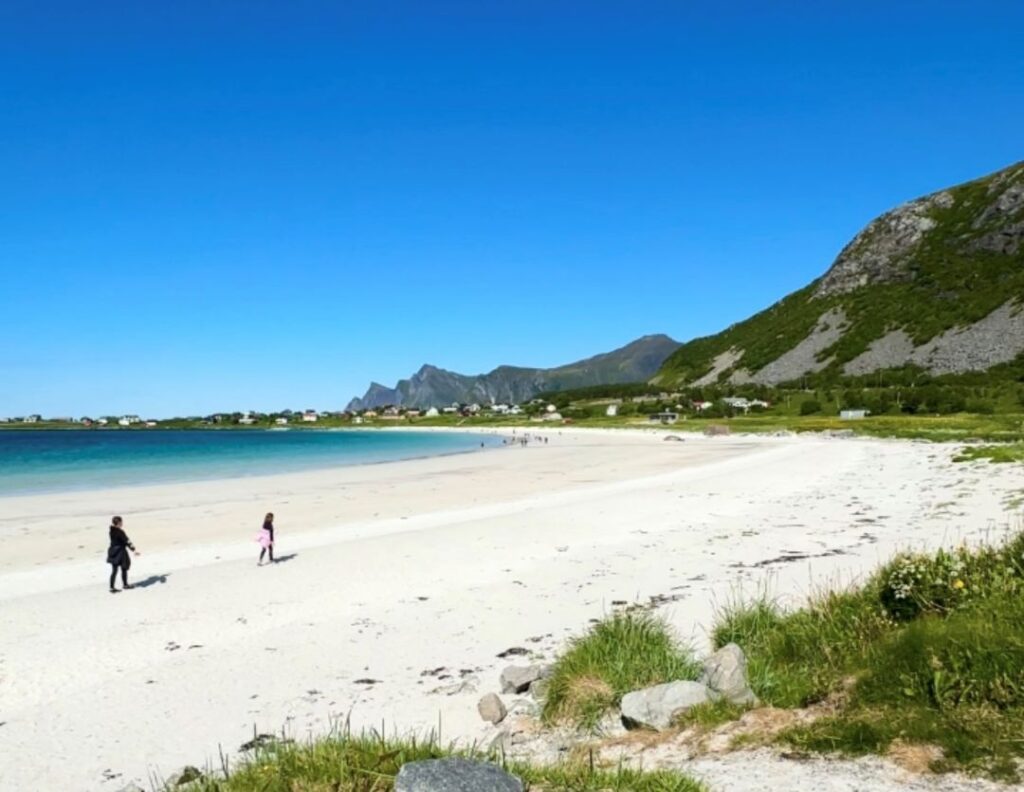
Ramberg is a really tiny settlement between Lofoten Beach Camp and Reine, but what this small community has is one of the most beautiful beaches in Lofoten.
Nestled along the E10, it is easily accessible, too, and even if you just pass by, you should stop and spend a few moments taking in the view here. On bright sunny days like on the photo above, it is simply stunning.
Apart from the beach, there is not really a lot going on in Ramberg, but there is an unmanned gas station here, as well as a small cafe and a supermarket.
What To Do
- Hiking to Nubben. A relatively easy hike with rewarding panoramic views over Ramberg and the ocean.
- Explore Flakstadpollen. A scenic fjord area nearby, perfect for kayaking or quiet walks.
- Swim (if you’re brave!). Why not go for it and take a bragable dip in the chilly but crystal-clear Arctic Ocean while you are hanging out on Ramberg Beach?
Where To Stay
There are a few places to stay if you want to hang around this incredible beach for a day or two.
Even though this is not a huge place, Ramberg is still a good starting point for lots of hikes and activities in western Lofoten. From Ramberg to Å in Lofoten, it is no more than about a 50-minute drive.
Where To Eat
Despite its modest size, you find one of the best restaurants in Lofoten in tiny Ramberg.
Ramberg Resort Restaurant is a good option for both lunch and dinner, whether you stay the night or not.
Fredvang
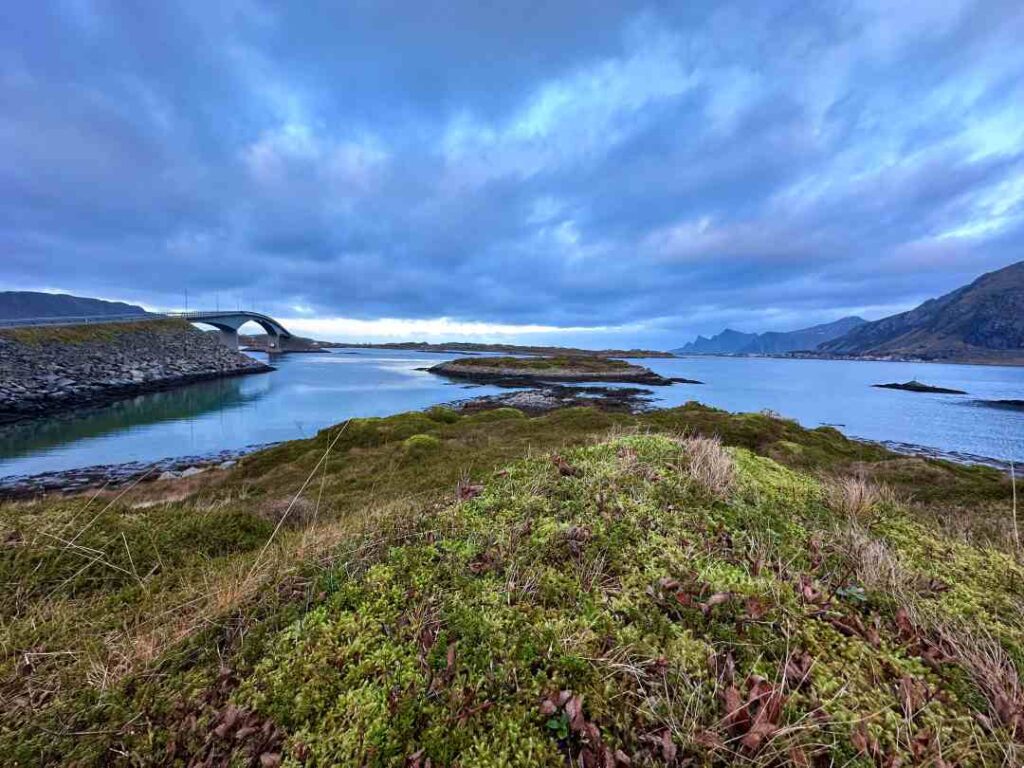
A few kilometers southwest of Ramberg, you arrive at an intersection, where if you take off from the E10, you will pass over two scenic bridges to Fredvang (you see one above in the photo).
I think there can not be much more than 20 houses over here (ok, maybe a few more), and Fredvang is home to Fredvang Beach (Sandbotnen on Google), another incredible golden sandy beach on the “outside”-part of Lofoten towards the ocean.
This is also the starting point for the famous hike to Ryten Mountain and Kvalvika Beach, a nice day hike considered an all-year-round destination. I loved this hike, and the view from the top is breathtaking of the sea and Kvalvika Beach below the summit!
Things To Do
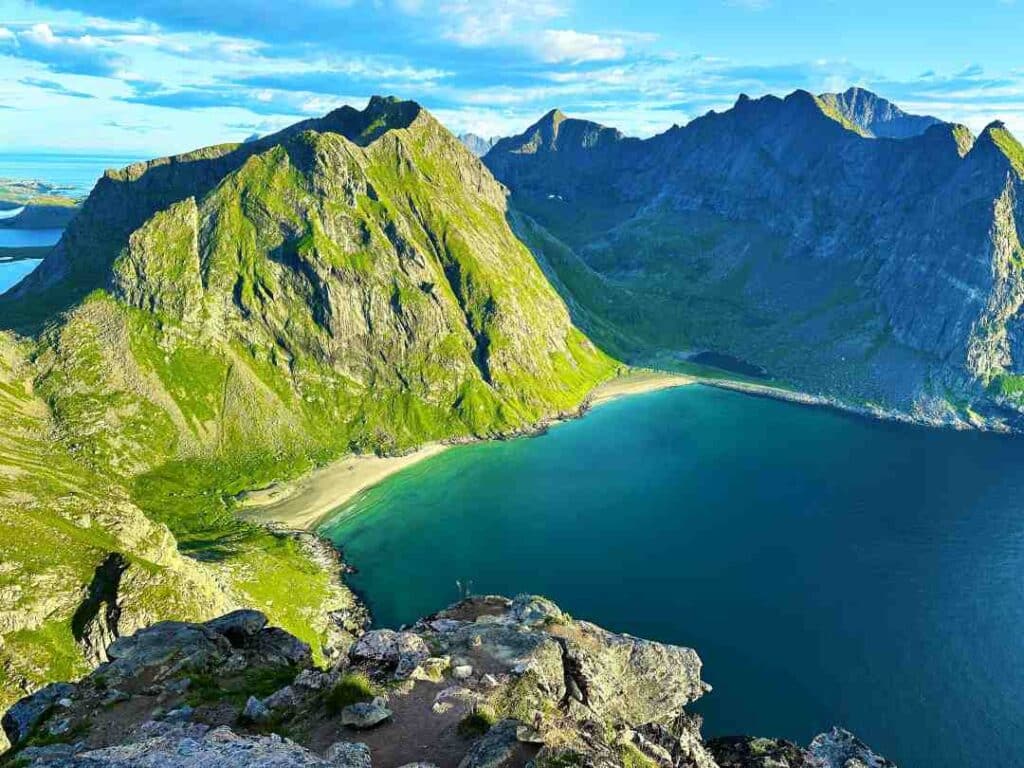
Fredvang is, like most small settlements and villages in Lofoten, tiny. It is also a great starting point for some of the most beautiful hikes in Lofoten.
- Ryten and Kvalvika Beach Hike (photo above, do one, or both at once)
- Hike to Roren
- Explore Ytresand Beach
- Photograph the beautiful Fredvang Bridges
- Wildlife spotting
- Camping (you can actually camp on the top of Ryten! NB: Leave No Trace!).
- Aurora Viewing (Fredvang, with little light pollution, is perfect for this in winter)
- See the midnight sun from Fredvang Beach (Sandbotnen) at midnight in July
Places To Stay
Lydersen Rorbuer Hostel & Apartments in Fredvang is a small, budget friendly place to stay if you want to spend a night or two in a really quiet part of western Lofoten.
Ryten & Kvalvika Trail Farm is another off-the-beaten-path accommodation option with great reviews from hikers. From here, you can just step outside your door, and start the hike to famous Ryten and Kvalvika Beach.
Where To Eat
The By The Way food truck in Fredvang is an absolute gem, according to lots of reviews on Google.
During the summer, there is also a cafe and outdoors seating by the (paid) parking area of the trailhead to Ryten and Kvalvika Beach.
The food is fresh and delicious, bursting with flavor and obviously made with care. Warm and friendly service, and the location is absolutely stunning beautifully set right behind the two iconic bridges to Fredvang, with a breathtaking view over the fjords.
📍Travel To Norway Tip: Park legally, and pay for your parking! There used to be huge problems with illegal parking along the narrow roads in Fredvang (and Lofoten) making traffic a nightmare. So, don’t be part of the problem when you visit!
9. The Blacksmith In Sund
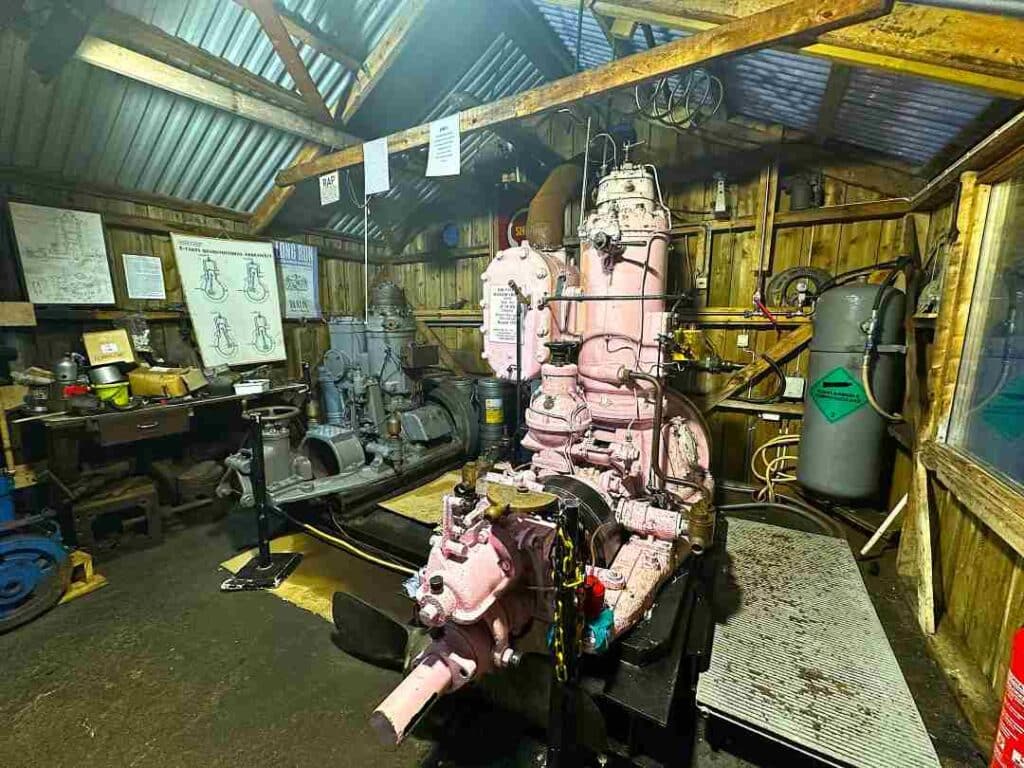
The tiny settlement of Sund is not home to much (or many), but there is a really low-key famous blacksmith living and working here. I visited with my parents over Christmas (when he was not really open, but he was super helpful anyway), and it was a really cool place.
Be fascinated by a blacksmith in action and also check out the exhibition of old classic fishing boat motors and fishing equipment.
You can also buy the figures that the blacksmith makes. They are expensive, but unique! We also enjoyed a coffee and cinnamon bun at the cafe right next to the museum.
10. Reine
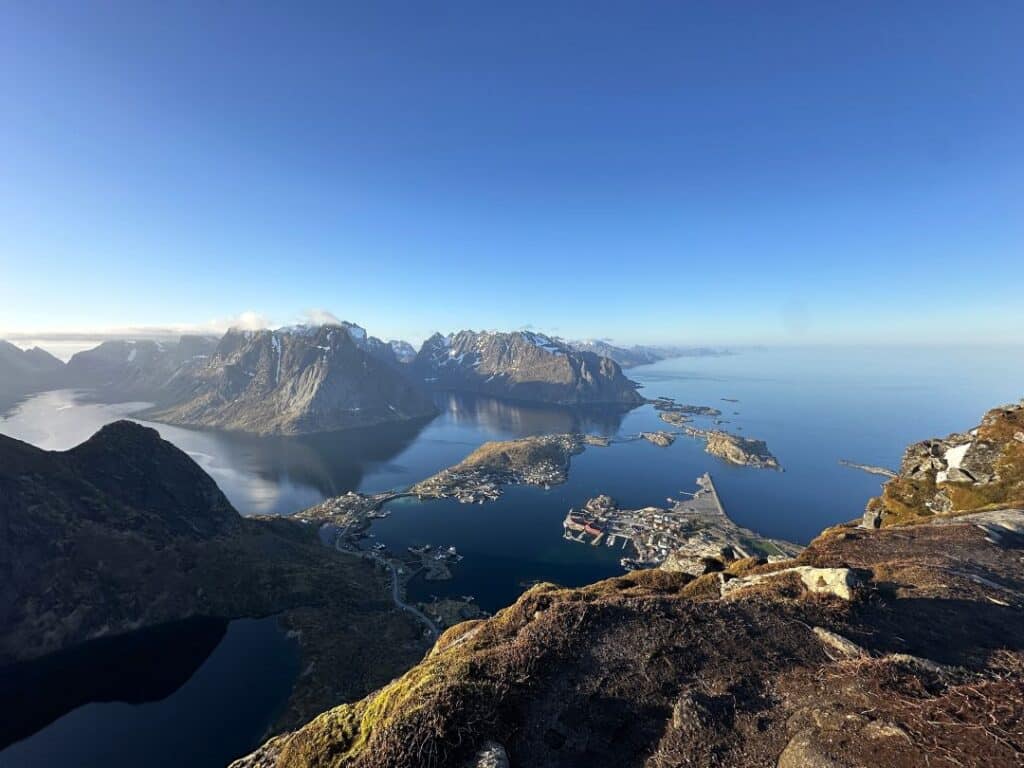
Reine is my home, and so I am possibly biased, but please, spend some time in Reine. If you just stop for coffee and gas here, you are missing out!
A small village nestled on a small island, the center of Reine has a gas station, cafe, a couple of (really good) restaurants, tourist information, an art gallery, and some shops.
This is also where you park for the hike/climb of the almost 2000 Sherpa stairs to summit the spectacular mountain Reinebringen.
This particular area consists of a chain of tiny islands, Hamnøy, Sakrisøy, Andøy, and Reine (you see them all from the top of Reinebringen).
Located in Moskenes Municipality, the ferry dock where the car ferry from Bodø arrives and departs is ten minutes away from the center of Reine.
Things To Do
- Hike/climb the Sherpa stairs to Reinebringen Mountain
- Go kayaking in the Reine Fjord
- Boat trip and hike to Bunes Beach
- Boat trip and hike to Horseid beach (2 days 1 night)
- SUP
- Yoga in Catogården 8 am every morning (call to book)
- Sauna & Ice Bath
- You find saunas at Reinefjorden Sjøhus, Eliassen, and Catogården
Read more in-depth about what to do in Reine in this article; this is where I live!
Where To Stay

There are no hotels in Reine, only fishermen’s cabins in larger or smaller resorts for rent.
Some rent out these cabins on Airbnb, and you can also find great homestays in Reine (like in my house, where I rent out two super charming rooms).
- Reinefjorden Sjøhus on Hamnøy Island, a small resort, slightly upscale
- Eliassen Rorbuer on Hamnøy, the largest cabin resort in Lofoten
- Sakrisøy Rorbuer (where the famous yellow rorbu is)
- Reine Rorbuer, Fisherman’s cabins in the center of Reine
- Catogården B&B in the center of Reine
Where To Eat
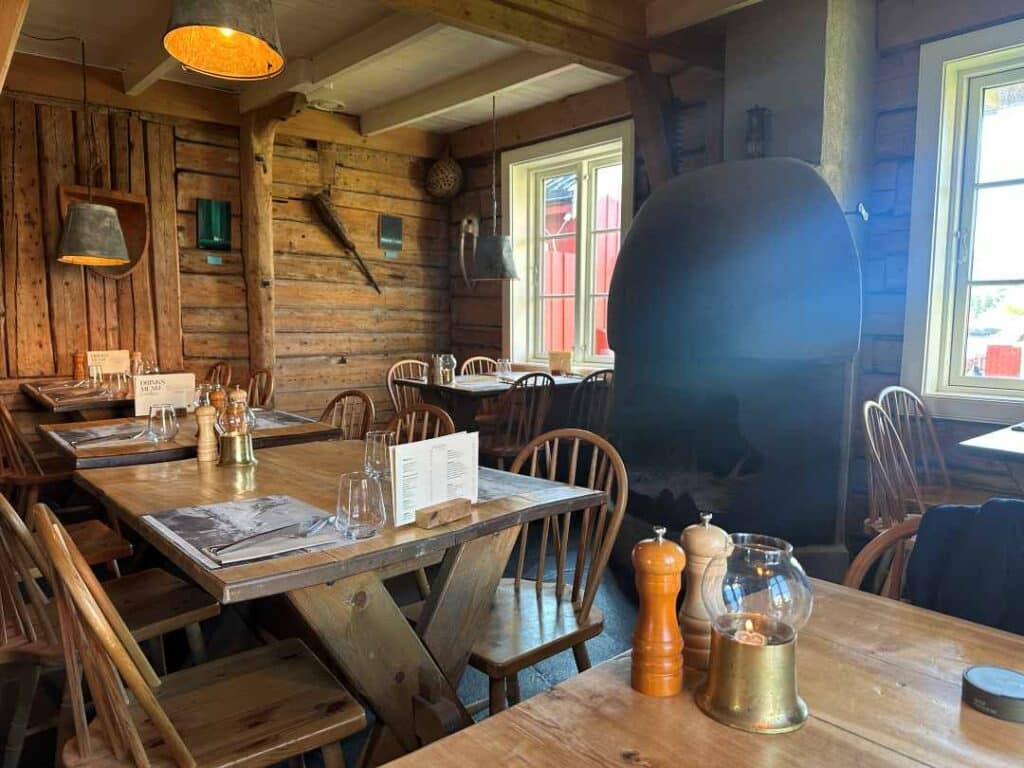
- Restaurant Gadus, on Hamnøy Island, Norwegian Italian Fusion
- Restaurant Underhuset on Sakrisøy, Norwegian Mexican Fusion
- Anita’s Seafood, daytime/early evening, laid-back restaurant and shop
- Tapperiet Bistro, charming restaurant with a large menu
- Gammelbua in Reine, high-end dining
Also read: 7 Best Restaurants In Reine From A Local
11. Sørvågen
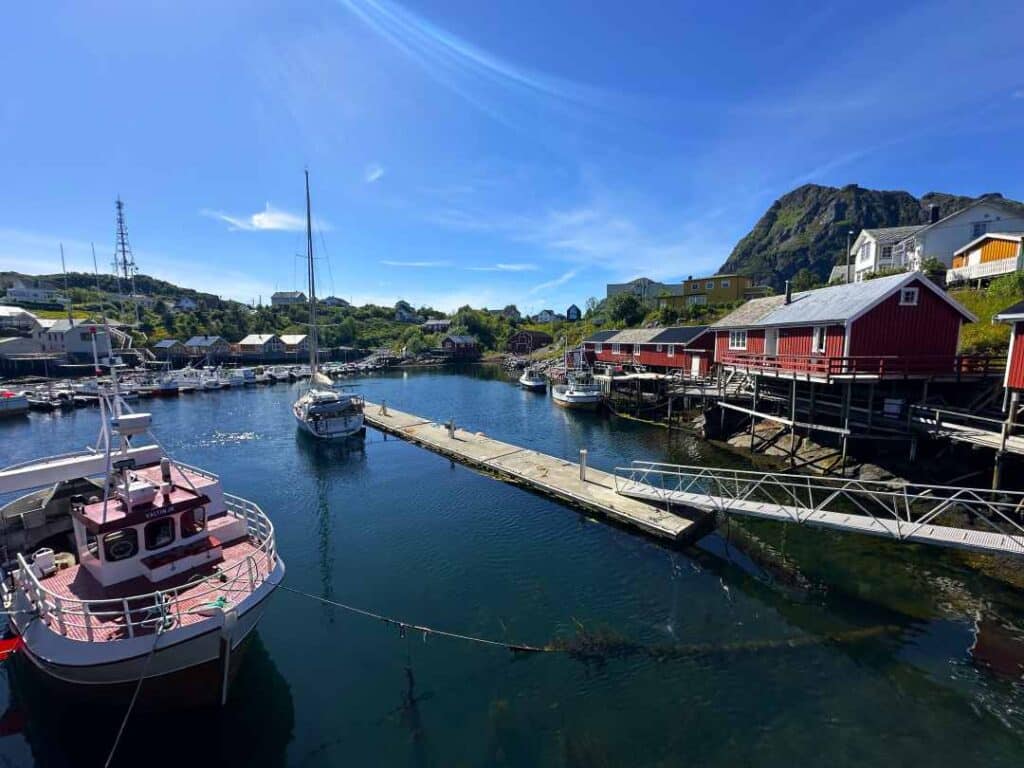
This is also where most locals in Moskenes Municipality lives, and you find two small supermarkets here, and both have a small selection of pharmcy items.
There is really no town center, but there is a really charming harbor surrounded by houses, cabins, and a few restaurants.
The popular Malstrom & Bird Safari starts from Sørvågen, from The Tide Hotel.
What To Do
Sørvågen is a great starting point for many amazing hikes, both day trips, and multi day trips if you want to venture into the Lofoten National Park.
Here are some of the most popular hikes starting in Sørvågen.
- Hike to Munkebu Cabin: moderate, 7+ hours, 5,5 km, 797 m elevation.
- Hike to Hermannsdalstinden: challenging, 12-13 hours from Sørvågen, 7 hours from Munkebu, elevation 1800 m from Sørvågen
- Hike to Tindstinden, moderate (not too far, but steep), 3 hours, 5 km, elevation 456 m
- Join the Malstrom & Bird Safari from The Tide
- Stroll around the Sørvågen Lake
- Visit Sørvågen Radio Museum
Where To Eat
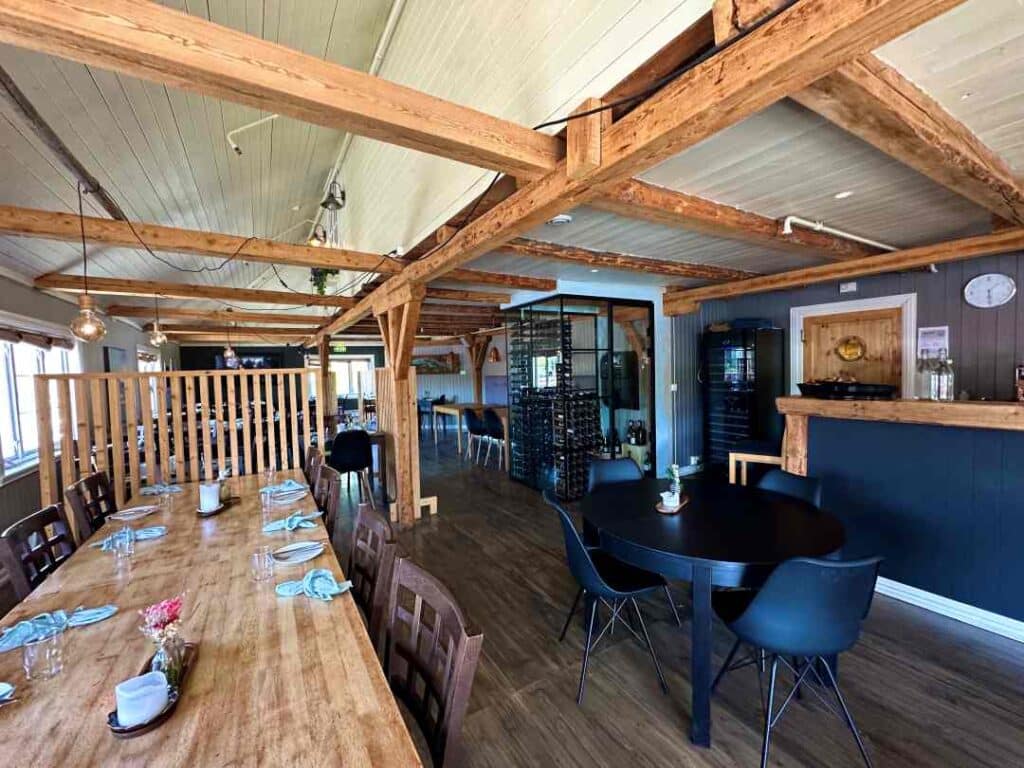
- Maren Anna Restaurant
- Havet Restaurant The Tide Hotel
- Gourmet: Holmen Restaurant
Where To Stay
Sørvågen is not a places where you find lots of Fisherman’s Cabins, but there are some, and one hotel.
- The Tide Hotel by the harbor
- The Tide Rorbuer by the harbor
- Lofoten Planet Boutique Hotel by Sørvågen Lake
- Budget: Sørvågen Inn
12. Å In Lofoten
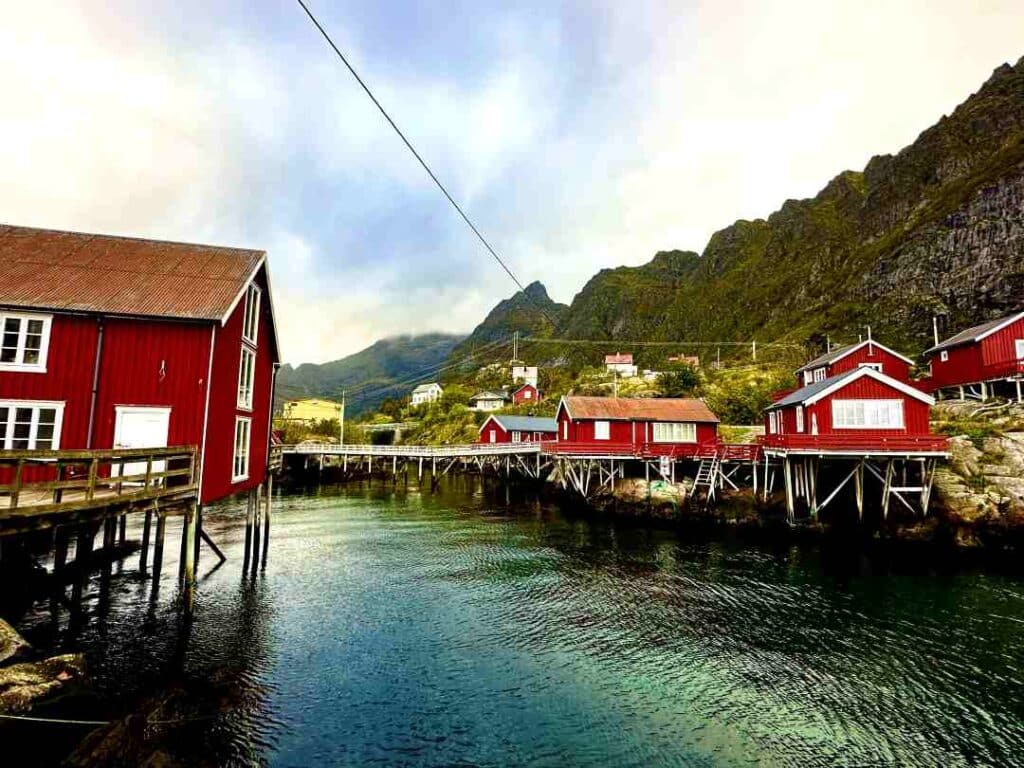
Å is the very last letter in the Norwegian alphabeth, and it is also the very last place on this peninsula, Å in Lofoten is the end of Lofoten, so to speak. After Å you find just mountains, then sea, and two islands south of Lofoten.
When you come out of the last tunnel along the E10, you will arrive at a parking lot, and this is where the road and Lofoten ends.
I tend to refer to Å in Lofoten almost like an outdoor museum, with a small village square around what used to be the væreier house back in the day, the Fisherman’s Village owner.
In Å today, you will find a small rorbu resort, a museum, a bakery where they do everything the old fashioned way (you must try the cinnamon buns here, they are world famous).
Spend some time strolling among the cabins of the village, walk the pier, have that cinnamon bun (get there early, it gets sold out), and maybe have lunch at the small rorbu resort?
What To Do
- Visit the Stockfish Museum
- Have a delicious cinnamon bun from the old bakery
- Walk to the end of the pier at sunset
- Visit the Norwegian Fishing Village Museum
- Have refreshments at Brygga Restaurant
- Short coastal walk in the outlands
Where To Stay
There are rorbu resorts in Å, as well as a hostel, and you can also find Airbnb accommodation here.
- Å Rorbuer Fishermans Cabins Resort
- Å Hamna Rorbuer
- Lofoten Å HI Hostel, budget and great for solo travelers
Where To Eat in Å
BONUS: Best Beaches In Lofoten
Lofoten is known for two things (ok, probably more), and that is its mountains – and its white, sandy, paradisiacal beaches with crystal clear waters that looks like it could be somewhere in the Caribbean (were it not for the temperature).
Even in July, the water is not exactly inviting. But invigorating, definitely. Go for a dip, go surfing, head out with a SUP, or just hang on the beach on a towel and savor the view.
I promise you, it will be iconic.
- Unstad Beach
- Uttakleiv Beach
- Ramberg Beach
- Kvalvika Beach
- Sandbotnen by Fredvang
- Horseid Beach (by boat only from Reine)
- Bunes Beach (by boat only from Reine)
FAQs Lofoten Islands
When Is The Best Time To Visit Lofoten
As always, it depends. Summer is great for hiking, kayaking, safe and easy (or easier) road trips, and any outdoors experiences. If you want to experience the midnight sun glowing from the horizon all night long, summer is also great.
Summer is also the peak tourist season, so you will not be alone. This is also the most expensive season to visit, as prices are higher than the rest of the year.
How do I get to Lofoten?
- By plane – Fly to Bodø or Evenes, then connect to airports like Leknes (LKN) or Svolvær (SVJ).
- By ferry – From Bodø to Moskenes (near Å) or to Svolvær.
- By car – Drive via the E10, which connects Lofoten to the mainland through beautiful coastal and mountain scenery.
- By bus – Routes connect with major towns and airports, but services can be limited.
Do I need a car in Lofoten?
If you want full freedom to explore, I will say yes. Having a car makes it much easier to reach remote beaches, trailheads, and villages.
That said, without a car, you can still get around by:
- Buses – They connect main towns but run on limited schedules.
- Guided tours – Great for Northern Lights, kayaking, or photography trips.
- Biking – In summer, cycling along the E10 and coastal roads is stunning, though the distances can be long.
Wrap Up Lofoten Islands Travel Guide
There you have it, the Ultimate Guide To The Lofoten Islands!
I hope you have found this guide helpful, and I hope you also see that you should not rush through the Lofoten Archipelago. There are a lot of things to do and explore here, on and off the beaten path.
Also, if you stay longer and travel less, you help us take care of the environment and nature, and you will support the local communities by spending your holiday budget in local shops, services, restaurants, and more.
So we can keep Lofoten as clean and beautiful as it is today, also for a long time into the future.
Welcome to Lofoten!